

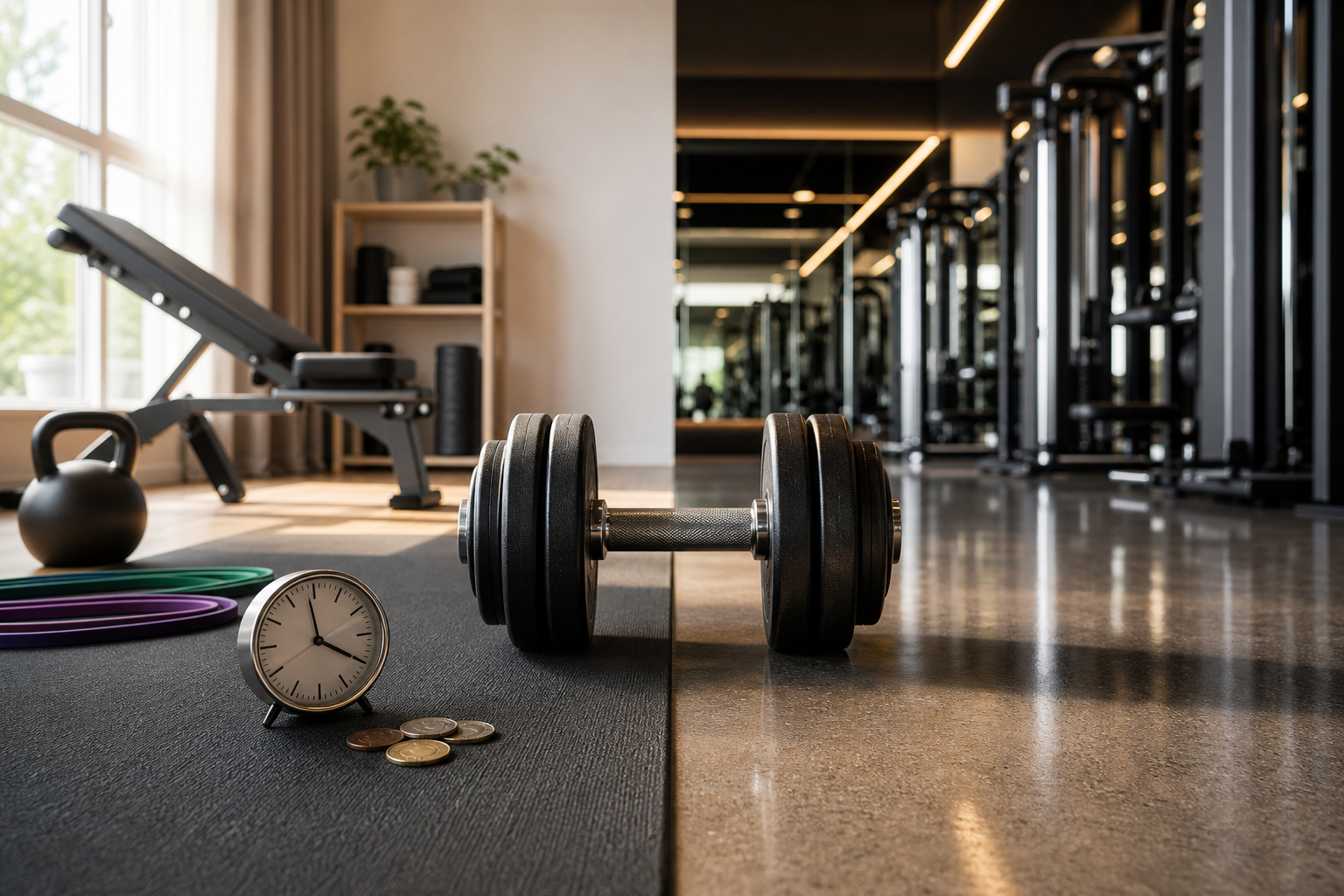
Introduction: The Real Question Is Not Which Gym Is Better, But Which One You Will Actually Use
The expensive part of fitness is not always the membership or the dumbbells; often, it is the routine that never quite becomes real. Are home gyms better than commercial gyms? Compare the 7 Key Differences That Could Save You Thousands is the question we hear from people who are not just comparing squat racks and monthly dues, but trying to protect their money, their time, their motivation, and that fragile promise they keep making to themselves.
In 2026, the answer is more complicated than it was even five years ago. Hybrid work has changed commuting patterns. A $50 monthly gym membership is now $600 a year before initiation fees, annual fees, parking, gas, childcare, or class add-ons. At the same time, home equipment has become easier to buy, easier to finance, and, sometimes, easier to regret.
At FitnessForLifeCo.com, we look at fitness through a lifelong lens. The best gym is not the most impressive one. It is the one that fits real homes, real schedules, real bodies, and real seasons of life: the parent training while a child naps, the older adult rebuilding balance, the beginner who does not yet want mirrors, the lifter who needs heavy plates and a spotter.
Based on our research, the decision usually turns on seven differences: total cost, time, equipment access, privacy, motivation, safety, and long-term sustainability. One of them will probably matter more than the others. That is where your real answer begins.

Are Home Gyms Better Than Commercial Gyms? The Short Answer for 2026
For many people, home gyms are better for consistency, privacy, family schedules, and long-term savings. Commercial gyms are often better for equipment variety, coaching, heavy lifting, classes, and the social energy that makes some people show up when they would otherwise stay home. In 2026, the smartest choice is less about identity—“gym person” or “home workout person”—and more about friction.
The health target is the same either way. The CDC physical activity guidance recommends adults get at least 150 minutes of moderate-intensity aerobic activity weekly, plus 2 days of muscle-strengthening activity. The HHS Physical Activity Guidelines and the WHO physical activity fact sheet echo similar benchmarks because consistency, not location, drives the health return.
| Person | Home gym | Commercial gym | Best fit |
|---|---|---|---|
| Beginner | Low-pressure practice | Instruction available | Home start or coached gym |
| Apartment dweller | Compact bands, mat, dumbbells | More space and machines | Hybrid |
| Strength athlete | Convenient if well-equipped | Racks, plates, spotters | Commercial gym |
| Parent | Flexible nap-time workouts | Possible childcare | Home or hybrid |
| Older adult | Private balance practice | Supervised strength work | Hybrid |
| Returning after a break | Gentle re-entry | Accountability and coaching | Depends on confidence |
We researched typical 2026 membership fees, starter equipment prices, and commuting assumptions. Someone training 2 days a week may value coaching and variety more than savings. Someone training 5 days a week at home may recover dozens of hours a year and reach break-even within 2 years.
Can home workouts really work? Yes. Muscle and cardiovascular gains depend on progressive overload, consistency, recovery, and adequate intensity. Your muscles do not know whether a squat happened in a garage, a basement, or under fluorescent lights beside a leg press. They know tension. They know repetition. They know whether you came back.
Difference 1: Total Cost Over 1, 3, and 5 Years
The first number people compare is usually too small. A $50 monthly commercial gym membership looks like $50, but over 12 months it becomes $600 before initiation fees, annual maintenance fees, premium classes, parking, gas, childcare, cancellation fees, locks, towels, drinks, and the protein bar bought because dinner is still 40 minutes away. Over 5 years, that same base membership becomes $3,000 before extras.
Home gyms reverse the pattern. The cost arrives early: resistance bands, adjustable dumbbells, kettlebells, a bench, a yoga mat, cardio equipment, rubber flooring, storage, repairs, and optional app subscriptions. A practical $1,200 setup can break even in roughly 24 months if it replaces a $50 membership. If two adults use it, the break-even point can drop near 12 months.
Based on our analysis, three 2026 home gym budgets make sense for most readers:
- Under $150 starter gym: resistance bands, jump rope, mat, door anchor, and a simple tracking notebook.
- $500–$1,000 strength setup: adjustable dumbbells, bench, bands, kettlebell, pull-up bar, and basic flooring.
- $2,000+ garage gym: rack, barbell, plates, bench, flooring, storage, and possibly a bike, rower, or treadmill.
So, is it cheaper to have a home gym? Often, yes—if you use it consistently for 2 to 5 years. No, if the treadmill becomes a coat rack, if financing interest turns a $1,500 purchase into $1,900, or if you need coaching you will not seek at home. Are home gyms better than commercial gyms? Compare the 7 Key Differences That Could Save You Thousands only becomes useful when the math includes behavior, not just receipts.

The Hidden Costs People Forget Until They Are Already Paying Them
Many comparisons stop at membership versus equipment, but the quieter costs are where thousands of dollars slip away. A 6-mile round trip, 4 days a week, becomes 1,248 miles a year. At the IRS 2026 standard mileage rate if applicable to your budgeting assumptions, that can represent hundreds of dollars in vehicle wear and fuel. Downtown parking at $4 per visit, 3 times weekly, adds more than $600 a year.
Commercial gym costs people forget include:
- Driving, parking, tolls, and winter-weather delays.
- Café smoothies, bottled drinks, toiletries, towel service, and locks.
- Childcare, class upgrades, guest fees, and unused months during busy seasons.
Home gyms have hidden costs too: space taken from a guest room, rubber flooring, noise control, upgraded outlets for treadmills, delivery fees, assembly time, and eventual resale or disposal. One parent we modeled paid $65 a month for a gym plus $40 a month in childcare. A basic basement dumbbell-and-band setup cost less than 5 months of that combined expense and allowed training during nap time.
We recommend calculating a personal 12-month cost using receipts, not guesses. Then multiply it by 3 and 5 years. The number may be uncomfortable. It will also be honest.
Difference 2: Time, Commute, and the Small Frictions That Break a Routine
Time is often the deciding factor because a 45-minute workout is rarely only 45 minutes. Packing a bag takes 5 minutes. Driving may take 15. Parking, changing, waiting for a rack, showering, and driving home can turn strength training into a 90-minute event. For someone with a toddler, aging parent, unpredictable job, or long commute, that extra time is not a detail. It is the reason the workout disappears.
In our experience, the people who benefit most from home gyms are not always the most disciplined. They are often the most interrupted. A busy professional who saves 25 minutes per workout by training at home, 4 times weekly, gains more than 86 hours per year. That is more than 10 full 8-hour workdays returned to the calendar.
We found that home gyms work especially well for micro-workouts: 10-minute strength circuits before a meeting, walking-pad intervals during work breaks, mobility while dinner cooks, or 3 sets of push-ups and rows after school drop-off. Those short sessions count. They may not look dramatic, but over 52 weeks they create a body that has been asked, again and again, to move.
Still, the commute can help some people. Leaving the house creates a boundary between work, caregiving, and training. A commercial gym can become the one place where no laundry buzzes and no email window blinks.
- Track door-to-door gym time for one normal week.
- Write down missed workouts and the exact reason they were missed.
- Test two home workouts before cancelling anything.
- Compare how you feel: rushed, focused, bored, relieved, or more consistent.
Difference 3: Equipment Variety, Training Goals, and Progression
Commercial gyms usually win on equipment. They offer squat racks, cable machines, leg presses, selectorized machines, heavy dumbbells, pools, saunas, indoor tracks, specialty machines, and enough plates for people whose goals require serious loading. If you are a powerlifter, bodybuilder, swimmer, or someone who trains best with variety, a good facility can be difficult to replace.
Home gyms compete differently. Adjustable dumbbells, resistance bands, suspension trainers, kettlebells, pull-up bars, compact benches, jump ropes, stationary bikes, and bodyweight progressions can train nearly every major movement pattern. The American College of Sports Medicine emphasizes regular aerobic and resistance training, and research indexed through PubMed Central supports resistance training for strength, function, and metabolic health across adulthood.
Can you build muscle with a home gym? Yes, if resistance increases over time. You can add load, reps, sets, range of motion, slower tempo, shorter rest, or harder variations. A beginner might start with a 20-pound goblet squat. Later, that becomes a split squat. Then a Bulgarian split squat with adjustable dumbbells. If strength goals keep climbing, the next step may be a barbell and rack—or a commercial gym.
The question, again, is practical: Are home gyms better than commercial gyms? Compare the 7 Key Differences That Could Save You Thousands by matching equipment to goals. A marathoner may need a treadmill less than a safe running route. A beginner may need two dumbbells more than 14 machines. A competitive lifter may need the gym, not because home training failed, but because ambition outgrew the room.
Difference 4: Motivation, Accountability, and the Danger of the Room You Can Avoid
A home gym removes excuses, but it also removes witnesses. No one sees you skip the warm-up. No one notices when the dumbbells remain under the desk. The same room that makes exercise easy can be walked past all day, quiet as a closed door.
Commercial gyms create accountability through trainers, classes, familiar faces, scheduled sessions, and the soft pressure of money already spent. Home gyms depend more on habit design: visible equipment, written plans, tracking, and household support. Studies indexed by the NIH/National Library of Medicine have repeatedly linked social support with better exercise adherence, especially when goals are specific and routines are reinforced over time.
We recommend building an accountability system before buying anything expensive:
- Put equipment where you can see it, not in a storage corner you avoid.
- Pair workouts with an existing cue: after coffee, before a shower, after school drop-off.
- Schedule 20-minute appointments on a real calendar.
- Use a printed checklist with boxes you physically mark.
- Keep a minimum workout: 5 squats, 5 incline push-ups, 5 rows, and a 5-minute walk.
At FitnessForLifeCo.com, we do not believe beginners need punishment or perfection. They need a plan gentle enough to repeat and clear enough to trust. Motivation is unreliable. Systems are kinder. They are also more durable.
Disclosure: As an Amazon Associate, I earn from qualifying purchases.
Difference 5: Privacy, Confidence, and Who Gets to Feel at Home in Fitness
Privacy is not a small issue. For beginners, older adults, larger-bodied exercisers, postpartum parents, people with disabilities, and those returning after injury, the hardest part of fitness may be being seen before they feel ready. A home gym can offer something commercial gyms cannot always provide: the chance to practice without performance.
At home, there is no waiting for machines, no mirror anxiety, no comparison, no dress code, no commute, and no fear that someone is watching an imperfect squat. That freedom matters. According to the WHO, more than 1 in 4 adults worldwide do not meet recommended physical activity levels. When embarrassment or uncertainty is one of the barriers, privacy can become the first bridge back.
Commercial gyms have strengths here too. Skilled trainers can correct form. Group classes can create belonging. Accessible gyms may provide machines, ramps, pools, or adaptive equipment that would be expensive or impossible to own. For some people, the gym becomes not a stage but a community.
Imagine an older adult practicing sit-to-stand strength work from a kitchen chair, wall push-ups in the hallway, and balance drills near a countertop. After 6 weeks, they join a local strength class with more confidence. Home was not a retreat from fitness culture. It was the doorway into it, opened on their own terms.
Difference 6: Safety, Coaching, Injury Risk, and Training Alone
Safety changes depending on where you train. Commercial gyms may offer staff, trainers, spotters, emergency protocols, and maintained equipment. Home gyms offer control, cleanliness, and fewer crowded spaces, but they usually provide less immediate help if something goes wrong.
The examples are plain. A solo lifter should not attempt a max barbell bench press without safeties. A treadmill needs adequate clearance behind it; many manufacturers recommend several feet of open space. Resistance bands should be inspected for tears before use because worn latex can snap. Heavy dumbbells need stable storage, especially in homes with children or pets.
We recommend beginners start with movement quality before heavy loading:
- Squat to a chair before loading deep squats.
- Hinge with a dowel before kettlebell deadlifts.
- Use incline push-ups before floor push-ups.
- Practice carries with light dumbbells for posture and grip.
- Add dead bugs and low-impact cardio for trunk control and endurance.
Older adults and people with medical conditions should follow physician guidance and prioritize balance, strength, and steady aerobic work. The CDC and HHS recommend 2 days of muscle-strengthening activity weekly for adults, and that becomes especially meaningful with age, when strength supports independence.
What are the disadvantages of a home gym? Less supervision, possible form errors, space hazards, equipment limits, and the temptation to skip warm-ups because the workout feels informal. The solution is not fear. It is structure: safer exercise choices, gradual progress, and honest limits.
Difference 7: Cleanliness, Crowds, Access, and Control Over the Environment
At home, you control the music, temperature, cleaning habits, machine availability, lighting, and timing. At a commercial gym, those details belong partly to the crowd. That may sound minor until the January rush fills every treadmill, Monday evening bench press waits stretch to 20 minutes, or the only open class conflicts with school pickup.
Access is one of the strongest arguments for a home gym. It is open at 5 a.m., midnight, during nap time, between meetings, or after a long shift. Some commercial gyms offer 24-hour access, but travel, weather, holidays, and peak-hour crowds still matter. In 2026, when many people still work hybrid schedules, a 15-minute gap at home can become a real workout. A 15-minute gap before a commute usually cannot.
Commercial gyms can be clean and well-managed. Shared surfaces, locker rooms, and busy equipment simply require personal habits: wipe machines, wash hands, wear sandals in showers, and avoid touching your face during training. Home gyms shift that responsibility to you. If the mat is dusty, there is no staff member coming.
Environmental control also affects neurodivergent exercisers, shift workers, caregivers, and people sensitive to noise or crowds. A shared apartment may make jumping exercises impossible because of downstairs neighbors. A garage gym may be too hot in July or too cold in February. These details are not preferences. They are the texture of daily life, and daily life decides what lasts.
How to Decide: A 6-Step Checklist Before You Spend or Cancel
Before you buy a $3,000 treadmill or sign a 12-month contract, slow the decision down. Most people do not need a dramatic commitment. They need a 30-day test that reveals what they will actually do when work runs late, children get sick, motivation thins, and the weather turns.
- Define your main goal: fat loss, strength, mobility, endurance, confidence, rehab support, or general health.
- Count realistic weekly training days: use your last 4 weeks, not your ideal week.
- Calculate 12-month and 5-year costs: include fees, apps, parking, fuel, childcare, financing interest, and resale value.
- Audit available space: measure floor area, ceiling height, storage, noise, ventilation, and electrical needs.
- Identify your motivation style: private self-starter, class-driven, coach-led, family-supported, or socially energized.
- Test for 30 days: try home workouts, visit a gym during peak hours, and notice which option you repeat.
Score each category from 1 to 5: cost, time, equipment needs, privacy, accountability, safety, and family fit. Add the totals for home gym, commercial gym, and hybrid. The highest score does not make the decision for you, but it tells you where the evidence points.
Based on our analysis, beginners often do well with bands and walking first. Busy professionals may choose home strength plus weekend classes. Parents may train at home weekdays. Powerlifters may keep the commercial gym. Are home gyms better than commercial gyms? Compare the 7 Key Differences That Could Save You Thousands becomes less abstract when each answer has a number beside it.
The Hybrid Option: When the Smartest Gym Is Both
The hybrid strategy is often the most honest one. Home workouts protect consistency. Commercial gym visits provide heavy lifting, classes, swimming, coaching, equipment variety, or simple time away from the house. You do not have to choose one identity forever.
We tested several weekly structures with common schedules in mind:
- Consistency plan: 3 home strength sessions plus 1 gym class.
- Strength and recovery plan: 2 home mobility or cardio sessions plus 2 commercial gym lifting days.
- Beginner confidence plan: 5 short home sessions, each 10 to 20 minutes, for 30 days.
- Parent plan: weekday home workouts, weekend gym session with childcare or partner coverage.
- Older adult plan: home balance drills 4 days weekly plus supervised strength training 1 to 2 days weekly.
Hybrid training can save money. Instead of paying for a premium unlimited membership, you might downgrade to off-peak access, a class pack, a community center, or pay-per-visit sessions while keeping dumbbells, bands, and a mat at home. If a premium membership costs $95 a month and an off-peak option costs $45, the $50 monthly difference becomes $600 a year—enough for a strong starter setup.
FitnessForLifeCo.com supports this middle path because lifelong fitness is rarely tidy. Parents can model movement at home while still using the gym for personal time. Older adults can pair home balance practice with supervised strength. Enthusiasts can maintain daily movement without giving up heavy equipment. The goal is not purity. It is continuity.
Conclusion: Choose the Gym That Makes Tomorrow’s Workout More Likely
The better gym is the one that reduces friction, supports safe progression, and helps you keep showing up after the first bright burst of motivation fades. For one person, that means a commercial gym with coaching, heavy equipment, and familiar faces. For another, it means a mat beside the bed, dumbbells in the corner, and 20 quiet minutes before the house wakes.
The seven differences are simple, but they cut deep: cost determines what you can sustain, time determines what you can repeat, equipment determines how far you can progress, motivation determines whether you start, privacy determines whether you feel safe enough to learn, safety determines how wisely you train, and environment control determines whether the space works with your life or against it.
Your next steps are concrete:
- Calculate your current fitness spending from receipts.
- Complete the 6-step checklist and score each option.
- Try 3 home workouts this week before buying major equipment.
- Visit any gym you are considering during peak hours.
- Wait 30 days before making a large purchase or signing a long contract.
At FitnessForLifeCo.com, our mission is to make fitness accessible, sustainable, and useful for real life. Explore our beginner-friendly home workout plans, no-equipment routines, strength progressions, and evidence-based habit strategies for 2026 and beyond. You do not need the perfect gym. You need a repeatable path toward strength, mobility, confidence, and lifelong vitality—and then you need to walk it, one ordinary day after another.
Key Takeaways
- Home gyms often win on consistency, privacy, family flexibility, and long-term savings, especially when used 3 to 5 days per week.
- Commercial gyms often win on coaching, heavy equipment, classes, social support, pools, racks, and specialized machines.
- A $50 monthly membership costs $600 per year before fees, while a $1,200 home gym may break even in about 24 months if it replaces that membership.
- The best decision comes from a 30-day test, a 12-month cost audit, and an honest look at your motivation style, available space, and safety needs.
- A hybrid approach may be the smartest option for many people: home workouts for routine, commercial gym visits for variety, coaching, or heavy training.
Frequently Asked Questions
Are home gyms better than commercial gyms for beginners?
Home gyms can be better for beginners who feel self-conscious or need a low-pressure start. Commercial gyms may be better if the beginner needs coaching, form checks, or structured classes.
Is it cheaper to have a home gym?
A home gym is usually cheaper over time if you use it consistently. A $1,200 setup can break even in about 24 months compared with a $50 monthly membership, and sooner if more than one person uses it.
Can you build muscle with a home gym?
Yes, you can build muscle with a home gym if you use progressive overload. That means increasing weight, reps, sets, range of motion, tempo, or exercise difficulty over time.
What are the disadvantages of a home gym?
The main disadvantages are less supervision, fewer machines, possible space limits, safety concerns when lifting alone, and lower accountability. Some people also struggle because the workout space is too easy to ignore.
Are commercial gyms worth it in 2026?
Commercial gyms are worth it if you use the equipment, classes, coaching, or social environment regularly. They may not be worth it if commute time, crowded hours, or unused months keep you from training consistently.
Are home gyms better than commercial gyms? Compare the 7 Key Differences That Could Save You Thousands—what matters most?
The most important differences are cost, time, equipment, motivation, privacy, safety, and control over the environment. The best choice is the one you will use consistently for months and years, not the one that looks best on paper.
Disclosure: As an Amazon Associate, I earn from qualifying purchases.
Discover more from Fitness For Life Company
Subscribe to get the latest posts sent to your email.