

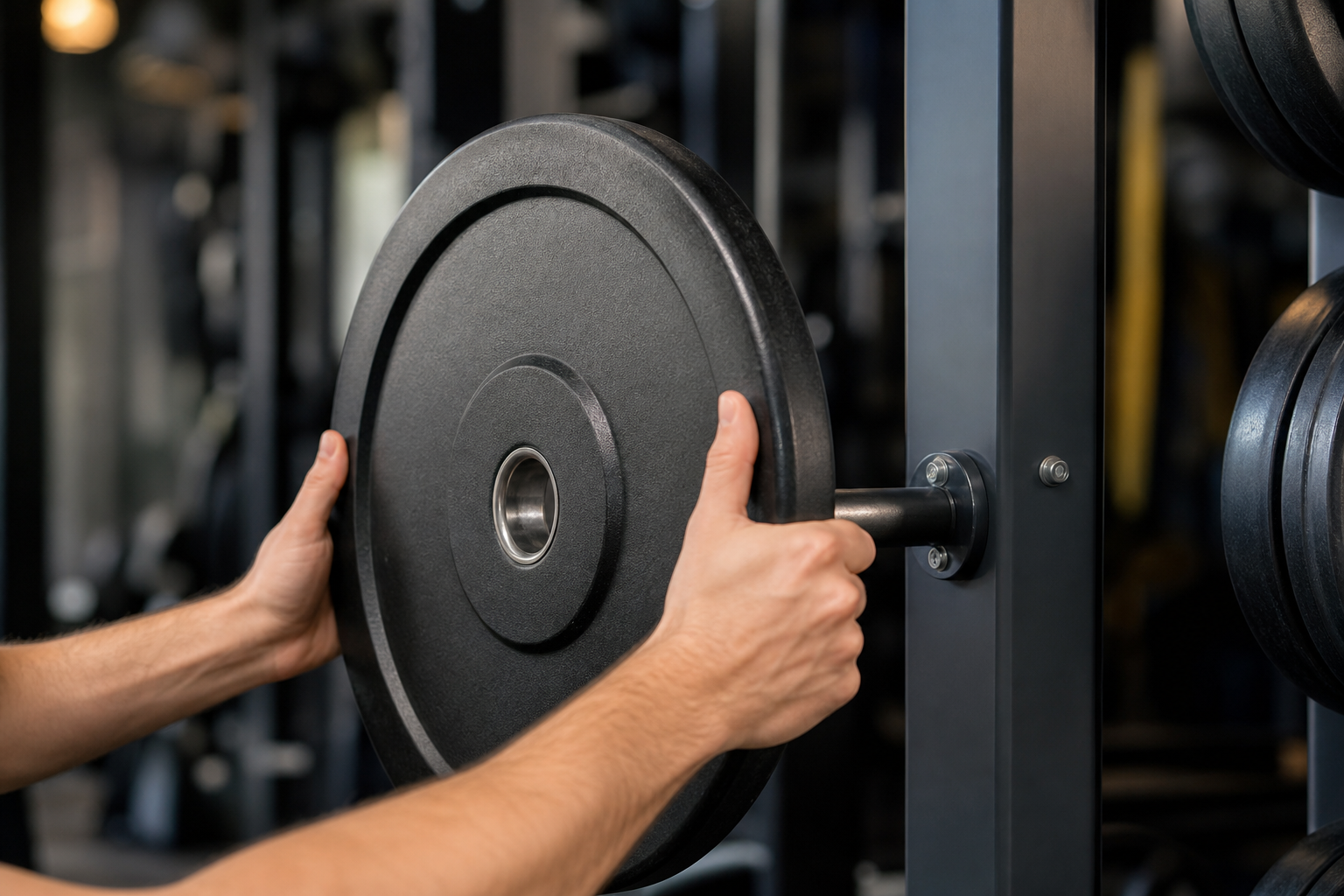
Introduction: The Small Act That Changes the Whole Gym
A gym can turn unwelcoming in less than 30 seconds: one machine left loaded, one path blocked, one person quietly deciding they don’t belong there. Should you re-rack weights after lifting? Train with Respect for Fellow Members is not just a question about manners. It’s about whether cleanup is optional courtesy, formal gym etiquette, or a safety responsibility in a shared training space.
Picture a beginner walking up to a leg press stacked with eight 45-pound plates—360 pounds before they even sit down. Nearby, an older adult sees the same machine and turns away because removing the load feels risky. A busy professional, already squeezing training into a 45-minute lunch break, loses 5 minutes just clearing someone else’s plates.
At FitnessForLifeCo.com, we see sustainable fitness as something that has to fit real people: beginners, parents, older adults, experienced lifters, and anyone trying to keep showing up. In 2026, shared exercise spaces affect consistency, confidence, injury risk, and community norms. Based on our research, small habits like re-racking shape whether a gym feels like a place to grow—or a place to endure.

Should you re-rack weights after lifting? The Clear Answer
Yes, you should re-rack weights after lifting because it keeps equipment available, reduces injury risk, and shows respect for every member who trains after you. That is the cleanest answer, and it holds whether you’re using a 10-pound dumbbell or loading a bar for a 405-pound deadlift.
Re-racking means returning dumbbells, barbells, Olympic plates, bumper plates, kettlebells, cable attachments, collars, resistance bands, mats, specialty handles, benches, and other movable equipment to their assigned storage area after use. It isn’t limited to plates. If you moved it from where it belonged, you are responsible for putting it back.
- Finish your set and make sure the area is clear.
- Unload evenly, especially on barbells and machines.
- Carry plates safely with two hands when needed.
- Return items by size: 45s with 45s, 25s with 25s, dumbbells in order.
- Wipe down the station before leaving.
Many commercial gyms include cleanup in membership rules, and some facilities issue warnings or revoke access after repeated violations. That matters because accessible fitness environments support public health: the CDC recommends adults get at least 150 minutes of moderate-intensity aerobic activity each week, plus muscle-strengthening work on 2 or more days. If equipment feels unusable, people are less likely to meet those targets.
Why Re-Racking Weights Is Basic Gym Etiquette
Gym etiquette is the quiet agreement that lets strangers train near one another without conflict, wasted time, or intimidation. Should you re-rack weights after lifting? Train with Respect for Fellow Members belongs in the same category as returning a shopping cart, clearing a table, or putting tools back where the next person can find them.
Based on our analysis of common gym policies, we found that the simplest etiquette rules are usually the ones most tied to safety and access: wipe equipment, share stations, don’t block walkways, and put weights away. These rules don’t require advanced knowledge. They require attention.
Consider a lifter who finishes a heavy dumbbell press and leaves two 100-pound dumbbells in the walking path. Another member, tired after a hard set, steps backward without looking. Maybe they trip. Maybe they don’t. Either way, everyone nearby now has to route around someone else’s unfinished task.
Poor etiquette hits different people differently. A beginner may feel embarrassed moving plates they didn’t load. An older adult may face an unnecessary lifting demand before their workout begins. A parent or professional with only 30 to 45 minutes may lose 10% of their training time before the first set. Respect, in practice, is often measured in minutes and obstacles removed.

Respect for Fellow Members Starts With Shared Equipment
A barbell is not personal territory. Neither is a squat rack, dumbbell tree, cable machine, leg press, bench, plyo box, or trap bar. These are shared tools in a rotating community, and each person gets temporary use—not ownership.
The common excuse is simple: The staff will put it away. But staff are there to maintain the gym, clean, assist members, monitor safety, repair equipment, and keep the facility running. They should not have to reset every station after every member. If five members each leave 6 plates on machines, the next users or staff may need to move 30 plates before anyone can train efficiently. At 45 pounds each, that’s 1,350 pounds of cleanup created by people who already had the strength to load the equipment.
Based on our analysis, disorder sends a message even when no one means to send it. Abandoned plates say, quietly, that someone else’s workout matters less. That message lands hardest on people who already feel unsure: the first-week member, the returning parent, the 68-year-old rebuilding strength after surgery.
In our experience, people are more likely to return to a gym that feels orderly, predictable, and welcoming. Sustainable fitness is not only about the workout plan. It’s about whether the room makes the next visit feel possible.
Safety Risks When Weights Are Left on the Floor or Machines
Weights left out create predictable hazards: dumbbells become trip risks, stacked plates pinch fingers, unevenly loaded barbells can tip, and machines become inaccessible to people who cannot safely unload them. In 2026, many gyms serve broader age ranges and ability levels than ever, which makes clear pathways and manageable equipment setup a safety issue, not a preference.
The U.S. Consumer Product Safety Commission NEISS injury data tracks emergency department injuries involving consumer products, including exercise equipment. The American College of Sports Medicine also emphasizes safe resistance training environments, proper technique, and appropriate equipment setup as part of injury prevention. These are not abstract concerns; they show up in the small moments when someone rushes, guesses, or works around a mess.
Picture a beginner at a squat rack. The bar is loaded with a 45-pound plate on each side. They remove both plates from the right side first. Suddenly the left side is much heavier, the bar tips, and what felt merely awkward becomes dangerous in seconds.
- Unload barbells one plate per side, alternating until clear.
- Keep walkways clear of dumbbells, kettlebells, bands, and collars.
- Never leave dumbbells near benches where feet naturally step.
- Ask staff for help with heavy, stuck, or awkward equipment.
How to Re-Rack Weights Correctly in 7 Simple Steps
Good cleanup is not complicated, but it does need a method. We recommend treating re-racking as the final set of each exercise: brief, deliberate, and finished before you move on. A 90-second reset after a 45-minute strength session still leaves 43 minutes and 30 seconds for training, while skipping it may cost several other members their warm-up time.
- Finish the set and check the space around you. Before moving plates, dumbbells, benches, or attachments, look for feet, bags, water bottles, and people passing behind you.
- Unload barbells evenly. Alternate sides so the bar does not tip or whip upward. One plate from the left, one from the right, then repeat.
- Return plates to matching pegs by size. Keep 45s with 45s, 25s with 25s, 10s with 10s, and small change plates where they belong.
- Place dumbbells back in numerical order. Handles should face out when possible, so the next member can find the right pair quickly.
- Return accessories to assigned areas. Cable handles, ankle straps, bands, collars, mats, foam rollers, kettlebells, medicine balls, EZ bars, trap bars, benches, and plyo boxes all count.
- Wipe down benches and machines. Focus on places touched by hands, backs, faces, and forearms.
- Scan the station before walking away. Ask: Could the next person start here safely without cleaning up after me?
What Counts as Re-Racking? Plates, Dumbbells, Cables, and More
Re-racking is not limited to barbell plates. It includes every item moved from its storage area or borrowed from another station. If you touched it, moved it, loaded it, borrowed it, or made it harder for the next person to begin, put it back.
Common items include Olympic plates, bumper plates, dumbbells, kettlebells, EZ bars, trap bars, collars, cable attachments, resistance bands, benches, plyo boxes, mats, foam rollers, and medicine balls. Even partial cleanup can create problems. Leaving one 45-pound plate on each side of a leg press may look harmless to a strong lifter, but it can stop a beginner, older adult, pregnant member, or injured athlete from using the machine safely.
We found that the clearest rule is also the fairest one: restore the station to a neutral starting point. Not your starting point. Not what you think most people can handle. Neutral.
Common Excuses for Not Re-Racking—and Better Choices
Most excuses for not re-racking sound reasonable for about 5 seconds. Then someone else has to pay for them with time, effort, or risk. Should you re-rack weights after lifting? Train with Respect for Fellow Members becomes especially clear when the excuses are placed beside better choices.
- “I’m in a hurry.” Budget 2 minutes at the end of your workout. Better yet, clean each station before moving to the next.
- “Someone else might use it.” Ask nearby members: “Are you waiting for this weight, or should I clear it?”
- “The gym pays staff.” Staff maintain the facility; members still share responsibility for basic order.
- “It was already messy.” Don’t add to it. Tell staff if an area is unsafe or completely disorganized.
- “The plates are too heavy.” Ask for help before loading beyond what you can unload safely.
At FitnessForLifeCo.com, we talk often about sustainable fitness. That includes reps and sets, but it also includes how we participate in a community. Based on our research, habits that take under 2 minutes are easier to attach to existing routines. We recommend treating cleanup as the final set of the workout—the one that trains awareness, patience, and respect.
Gym Etiquette for Beginners Who Feel Unsure
No one is born knowing where every cable handle, change plate, bench, or specialty bar belongs. Beginners often enter a gym feeling as if every object has a rule attached to it and everyone else received the rulebook years ago. They didn’t. They learned by watching, asking, and making small corrections.
If you’re new, start with visible clues. Look for labels on racks. Match items by size, shape, or number. Copy the layout of nearby storage trees. If the 20-pound dumbbells sit between the 15s and 25s, the pattern has already done half the teaching. When you’re unsure, ask staff: “Where should this go?” That question is better than guessing and leaving a hazard behind.
Useful scripts help because nerves make people forget simple words. Try: “Hey, are you still using these plates, or can I help put them back?” Or: “I’m new here—does this handle go on the cable wall?”
The CDC notes that regular physical activity supports brain health, heart health, weight management, bone and muscle strength, and daily function. Learning gym manners early builds confidence, and confidence helps people keep showing up long after motivation fades.
When Someone Else Doesn’t Re-Rack: What to Do Without Starting a Fight
When someone leaves a station loaded, the goal is not to win an argument. The goal is to make the space usable while keeping the tone of the gym intact. That matters, especially for beginners and older members who may already feel watched.
- Pause first. The person may still be using the equipment during a superset or rest period.
- Assess the risk. Is the weight blocking a walkway? Is a bar unevenly loaded? Is someone likely to trip?
- Ask politely once. Use a normal voice, not a performance voice.
- Involve staff if needed. Repeated or unsafe behavior is their responsibility to address.
Natural scripts work best: “Are you finished with this station?” or “Would you mind clearing those plates when you’re done?” If someone seems aggressive, if the situation feels unsafe, or if the issue involves repeated rule-breaking, don’t confront them. Tell staff.
Here’s the version we recommend: a member leaves a squat rack loaded and walks away to talk. Another member asks once, waits briefly, then alerts staff instead of turning the exchange into a public argument. The gym stays calmer. The message still gets delivered.
The Hidden Accessibility Issue Competitors Often Miss
Abandoned weights are not only a manners issue. They are an accessibility issue. What is easy for one strong lifter may be impossible or risky for someone recovering from injury, pregnant, older, disabled, or new to strength training.
A 70-year-old member approaches a leg press loaded with 360 pounds and decides not to use it. A postpartum parent needs a flat bench but finds it buried under dumbbells and a backpack. A wheelchair user moves through the free-weight area and finds plates left in the aisle, turning a training floor into a maze. None of these barriers has to be dramatic to be real.
Broader access guidance from ADA.gov reminds us that public spaces should be usable by people with disabilities. The World Health Organization recommends adults complete 150 to 300 minutes of moderate-intensity aerobic activity weekly, plus muscle-strengthening activities on 2 or more days. Yet access to movement depends partly on whether people can safely reach and use equipment.
We recommend gyms support members with labeled storage, clear signage, staff walkthroughs every 30 to 60 minutes, accessible plate storage heights, and onboarding that includes cleanup norms. FitnessForLifeCo.com’s mission is lifelong fitness for real bodies. That requires rooms where different ages, abilities, and histories can train without unnecessary barriers.
Build the Habit: Make Re-Racking Part of Your Training Routine
The best time to re-rack is immediately after each exercise, before fatigue and rushing take over. If you save every cleanup task until the end, you create the perfect conditions for forgetting: tired hands, a busy brain, a phone reminder, a child pickup, a meeting in 12 minutes.
Based on our analysis of habit-building research, cleanup works best when attached to a cue-routine-reward loop. The cue is finishing your last set. The routine is unload, return, wipe, scan. The reward is moving to the next exercise with a clear station behind you. Small, repeatable loops become automatic faster than vague intentions.
- Finish your last set.
- Breathe for 10 seconds.
- Unload evenly.
- Return equipment to its home.
- Wipe the station.
- Log the set.
- Move on.
Busy professionals and parents can set a workout timer with a 3-minute cleanup buffer, choose supersets near the same equipment zone, and avoid spreading gear across the gym. Advanced lifters should plan plate changes with training partners so the strongest person isn’t the only one unloading and no barbell gets left half-cleared.
Conclusion: Leave the Gym Better Than You Found It
Re-racking weights is a small act, but it carries safety, respect, access, and community inside it. Should you re-rack weights after lifting? Train with Respect for Fellow Members has a simple answer, but the reason behind it is bigger than a tidy rack.
During your next workout, return every item you use. Clear walkways. Unload barbells evenly. Put dumbbells back in order. Wipe surfaces touched by hands, backs, and faces. Help when appropriate. Speak kindly when problems arise. If a machine or weight is too heavy to reset safely, ask staff instead of forcing it or abandoning it.
Fitness should enhance life, not complicate it. At FitnessForLifeCo.com, we believe lifelong vitality grows from repeatable habits inside and outside the gym: the set you finish, the breath you take, the plate you put back so someone else can begin. Explore FitnessForLifeCo.com for practical strength training, beginner-friendly routines, mobility guidance, and sustainable fitness habits for every stage of life.
Then imagine the next person approaching the rack. They find it ready. They begin—not because the gym is perfect, but because someone before them chose to care.
Key Takeaways
- Re-racking weights is both gym etiquette and a safety responsibility in a shared training space.
- Return everything you move: plates, dumbbells, cable attachments, bands, mats, benches, collars, and specialty equipment.
- Unload barbells and machines evenly, keep walkways clear, and ask staff for help with heavy or awkward equipment.
- Poor cleanup affects beginners, older adults, parents, busy professionals, disabled members, and anyone with limited time or mobility.
- Make cleanup the final set of each exercise so respect becomes part of your training routine.
Frequently Asked Questions
Should you re-rack weights after lifting every time?
Yes. You should re-rack weights after lifting every time because the equipment is shared, and the next person should not have to unload or search for what you used. Should you re-rack weights after lifting? Train with Respect for Fellow Members is the standard to follow in any gym.
What does re-racking weights mean?
Re-racking means returning plates, dumbbells, kettlebells, barbells, collars, cable attachments, mats, bands, and benches to their assigned storage areas. If you moved it, loaded it, borrowed it, or made the station harder to use, put it back.
Is not re-racking weights dangerous?
It can be. Weights left on the floor create trip hazards, unevenly loaded barbells can tip, and loaded machines may be unsafe for beginners, older adults, or injured members to unload.
What if someone else left the weights out before me?
Do not add to the mess. If you can safely return the equipment, do so; if the area is unsafe, tell staff. Leaving it worse makes the problem harder for the next member.
Can I leave plates on a machine if someone might use the same weight?
Only if you ask and someone clearly says they want it left loaded. Otherwise, return the machine to a neutral starting point so anyone can use it safely.
What should beginners do if they do not know where equipment belongs?
Look for labels, match items by size or shape, and copy the layout of nearby racks. If you are unsure, ask staff a simple question like, “Where should this go?”
Discover more from Fitness For Life Company
Subscribe to get the latest posts sent to your email.